


.svg)
.svg)

16.09.2026
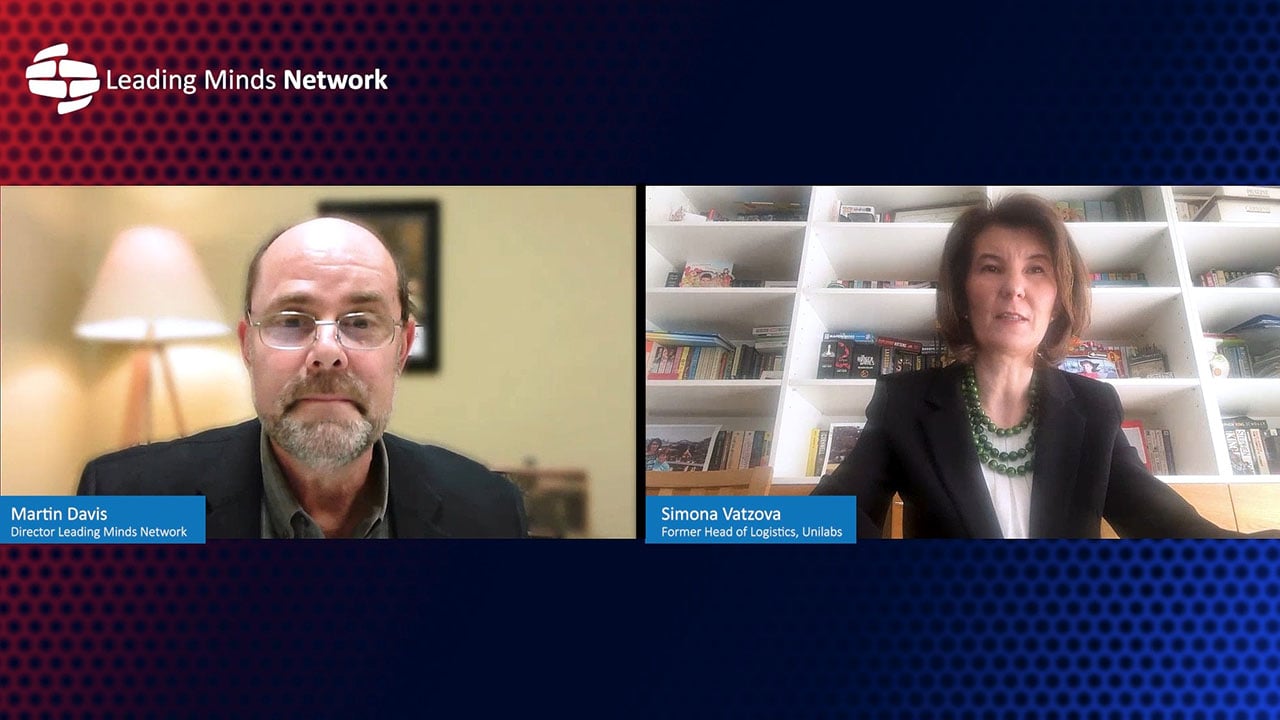

Watch the full interview.
Geopolitics Test the Cold Chain: Why Pharma Must Shift from Efficiency to Resiliency
Published April 2026 | Leading Minds Network
Executive Summary
Geopolitical disruptions in the Middle East have exposed a critical vulnerability in global pharmaceutical supply chains—especially for temperature‑controlled medicines. As key air cargo hubs such as Dubai, Doha, and Abu Dhabi face restrictions, the loss of capacity can reach 20–25% of global pharma air freight overnight, triggering cascading risks across Europe–Asia lanes.
While patients may not feel the impact immediately, supply chains begin destabilizing within hours, leaving organizations with only a 4–6 week window before shortages appear during sustained disruptions. The highest risks occur not in flight, but during unplanned ground delays, non‑validated handoffs, and extended dwell times, where temperature excursions commonly occur.
True resilience requires a shift from cost optimization to optionality: multiple validated corridors, alternative hubs, diversified carrier relationships, real‑time visibility, and proactive stress testing. Packaging alone only buys time—network design and visibility create survival.
The leaders who treat logistics as strategic infrastructure, rather than a transactional cost center, will be best positioned to protect patient access in an era where disruption is no longer the exception, but the baseline.
For leaders responsible for ensuring uninterrupted patient access to life‑saving therapies, the discussion offers both a warning and a roadmap. The central message is clear: supply chains optimized solely for cost and efficiency are no longer fit for today’s risk environment.
Regional Disruption with Global Consequences
Recent instability across the Middle East during the Iran War has forced airlines and cargo operators to suspend, reroute, or tightly control flights through key hubs such as Dubai, Doha, and Abu Dhabi. While these hubs are now operational again, they remain under restrictive conditions that reduce capacity and flexibility.
These airports are not just transit points—they are the backbone of pharmaceutical air logistics between Europe and Asia. Designed explicitly for high‑volume, temperature‑controlled handling, they enable the efficient movement of biologics, vaccines, and advanced therapies. When these corridors tighten or shut down, the system feels the impact almost immediately.
As Simona Vatzova explains, pharmaceutical products account for roughly 20–30% of global air cargo volume, depending on aircraft type. Losing even a portion of this capacity overnight creates a systemic shock: rates rise, capacity evaporates, and competition for lift intensifies across alternative lanes.
How Quickly Does Risk Reach the Patient?
One of the most critical insights from the conversation is how fast disruption builds, even if patient impact is not immediate.
Within the first 24–48 hours, global pharma logistics organizations typically activate “control tower” mode—mapping exposed plants, identifying shipments stranded in hubs, and scrambling to rebook capacity. Safety stock and in‑transit inventory may buffer the patient initially, but the countdown starts almost instantly.
“In a sustained disruption, you realistically have four to six weeks before shortages begin to surface.”
Simona Vatzova,
Senior Global Logistics Leader
The challenge is that many companies do not know precisely where their failure points are until they reach them.
How Do Cold Chains Fail in the Unplanned Moments?
A common misconception in pharmaceutical logistics is that the highest risk occurs during flight. In reality, Vatzova emphasizes, most failures happen on the ground—during extended dwell times, unplanned handoffs, or handling at non‑validated facilities.
Cold chains, by design, do not tolerate uncertainty well. Route changes introduce variability in:
- Airport ground handling quality
- Exposure during tarmac delays
- Transfers through non‑certified or unfamiliar hubs
The cost of failure is enormous. Industry estimates suggest that up to 50% of all vaccines are lost annually due to temperature excursions, representing approximately $35 billion in losses—even under “normal” operating conditions. Layer a geopolitical disruption on top of this, and risks multiply rapidly.
What Are the Most Vulnerable Cold Chain Products?
Sustainability consistently ranks among the top resilience priorities for pharmaceutical organizations. The two are not competing goals—they are mutually reinforcing.
Not all pharmaceutical products face equal risk. The discussion highlights vulnerability among:
- Cell and gene therapies
- Biologics
- Vaccines
- Short‑shelf‑life oncology treatments
These therapies offer limited tolerance for delays, temperature variance, or extended transit times. Reports already point out early warning signals for cancer treatments if current disruptions extend beyond two to three months. For organizations expanding pipelines in advanced therapies, this is a strategic red flag that cannot be ignored.
Optionality: Why Is It Easy to Say, Hard to Build?
One of the most powerful concepts discussed is optionality—the ability to execute multiple logistics scenarios when plans fail.
In theory, optionality sounds simple. In practice, it is expensive, operationally complex, and slow to build. According to Vatzova, true optionality requires:
- Multiple validated transport lanes
- Pre‑qualified alternative hubs
- More than one carrier or forwarder relationship
- Redundancy was built into network design—not retrofitted during crisis
Thermal packaging plays an important role, but it is not a substitute for network resilience. Better packaging “buys time,” not continuity. Once its limits are exceeded, the shipment is still lost.
How To Move from Cost Optimization to Strategic Infrastructure?
A recurring theme of the discussion is the industry’s historical bias toward cost efficiency. While that mindset is shifting, it has not yet fully caught up with today’s risk profile.
Temperature‑controlled pharma logistics already represent an $80 billion market, projected to reach $140 billion by 2030. At the same time, therapies are becoming more fragile and more valuable. This creates an uncomfortable but necessary question for leadership teams and boards alike: should we optimize for lowest cost—or acceptable risk?
“If a network cannot survive losing one region, it isn’t a supply chain. It’s a risk exposure.”
Simona Vatzova,
Senior Global Logistics Leader
Why Is Cold Chain Visibility No Longer Optional?
Real‑time monitoring and predictive analytics emerge as non‑negotiable enablers of resilience.
Modern visibility platforms allow companies to:
- Track location and temperature in real time
- Detect delays early
- Intervene by rerouting, reprioritizing, or escalating shipments
These tools are not perfect—but without them, organizations operate blindly during disruption. Vatzova notes that investment in cold‑chain monitoring has grown rapidly, reflecting the industry’s acknowledgment that reactive solutions arrive too late.
Crucially, technology alone is not sufficient. Companies must pair digital investments with trained teams, decision protocols, and escalation processes that turn data into action.
Stress‑Test Your Biopharma Supply Chain Network Before Reality Does
Asked what pharma executives should prioritize in the next 6–12 months, Vatzova’s advice is direct:
“Don’t wait for the next disruption to test your network. Test it yourself.”
Scenario planning, corridor‑loss simulations, and systematic stress testing reveal vulnerabilities long before patients are affected. Organizations that treat resilience as an ongoing capability—not a one‑time project—consistently emerge stronger after disruptions.
With geopolitical instability becoming the “new baseline,” supply chain resilience is no longer a defensive investment. It is strategic infrastructure.
The Leadership Imperative During Supply Chain Disruption
The conversation closes with a forward‑looking challenge: supply chain leaders must elevate logistics from an operational function to a board‑level strategic priority. That means:
- Investing in alternative corridors
- Building true partnerships rather than transactional contracts
- Accepting structural cost increases in exchange for continuity
- Designing networks that protect patient access, not just P&L targets
In an era where disruptions are frequent, unpredictable, and global, the organizations that adapt fastest will be those that recognize a simple truth:
Resilient supply chains don’t just move products—they safeguard patients.



Leave a Comment